

Introduction
The Shadowserver Foundation has recently begun daily scanning for publicly exposed instances of 15 autonomous artificial intelligence (AI) Attack Frameworks (also known as Agentic Offensive Frameworks). These tools enable large language model (LLM) agents to conduct reconnaissance and exploitation of vulnerable systems with the goal of minimal human involvement, which can reduce the time and expertise needed to carry out an intrusion.
The frameworks are openly available to install, and some are forks of existing and earlier frameworks. AntiFox and ScopeWeaver, for example, are derived from ARTEX. Not all frameworks are malicious in nature: some may be built for authorized penetration testing and red-teaming, and security teams use them to find and fix weaknesses in the infrastructure they protect. Our scans find publicly exposed instances of these frameworks, and our Global Honeypot Sensor Network receives traffic from IP addresses running them and the activity behind them, as described below.
What Our Scans Found
Our daily internet-wide scans currently identify the following frameworks: AntiFox, ARTEX Gateway, BugTraceAI, Cairn, CyberStrikeAI, Decepticon, Luanniao (LuaN1ao) Penetration Agent, PentAGI, PentestCode, PentestGPT, RedAmon, ScopeWeaver, Strix, T3MP3ST Dashboard and Xalgorix, with more being added.
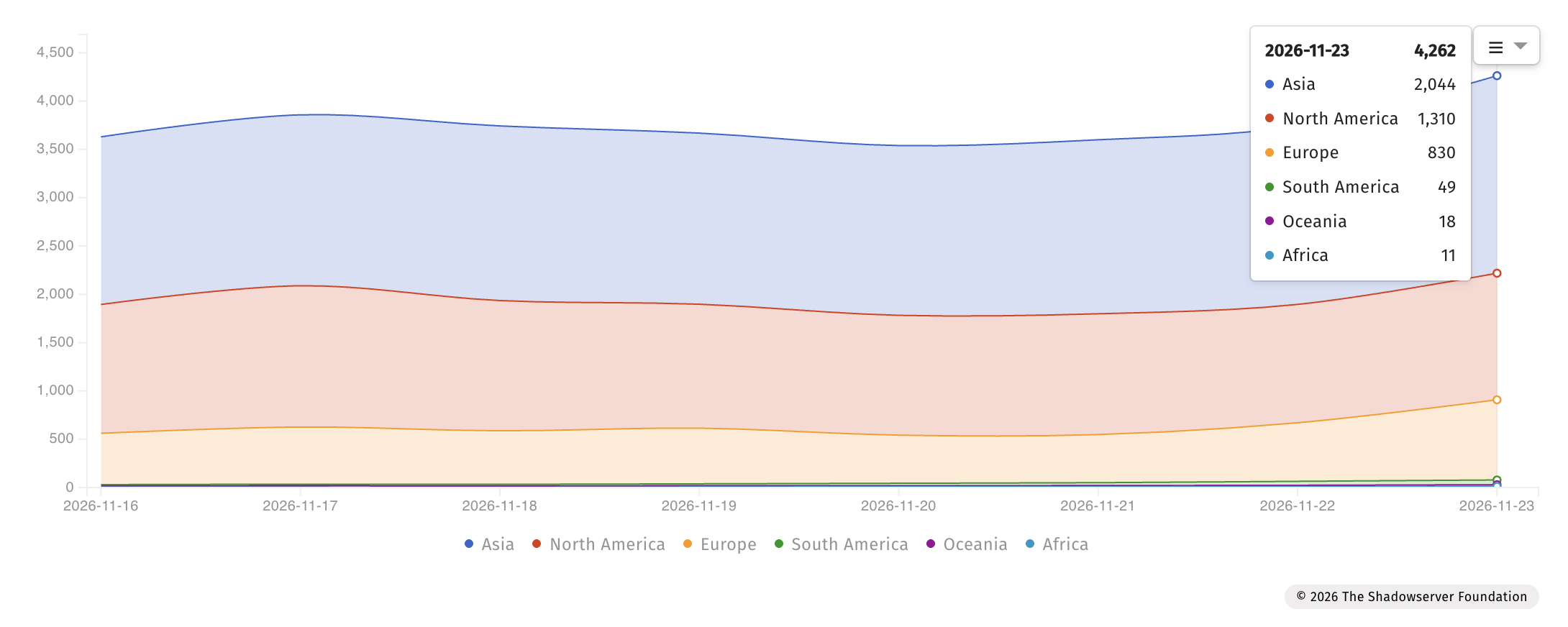
Exposed AI Attack Framework instances per region – linear scale. Link to public Dashboard 2026-11-23.
As of November 23rd 2026, our daily scans identified around 4200 exposed agentic AI Attack Frameworks. This is an increase from just under 3,700 the day before. Overall, in the past week, the number dropped slightly from a 3,850 peak on the 17th, then started to rise gradually from the 21st onward. Nearly half of these instances were in Asia, over a third in North America and most of the rest in Europe. Aggregated daily country-level statistics are available on our public Dashboard and are shown in the chart and world map below. The public Dashboard contains no IP-level data; detailed data is shared in our free daily network reports.
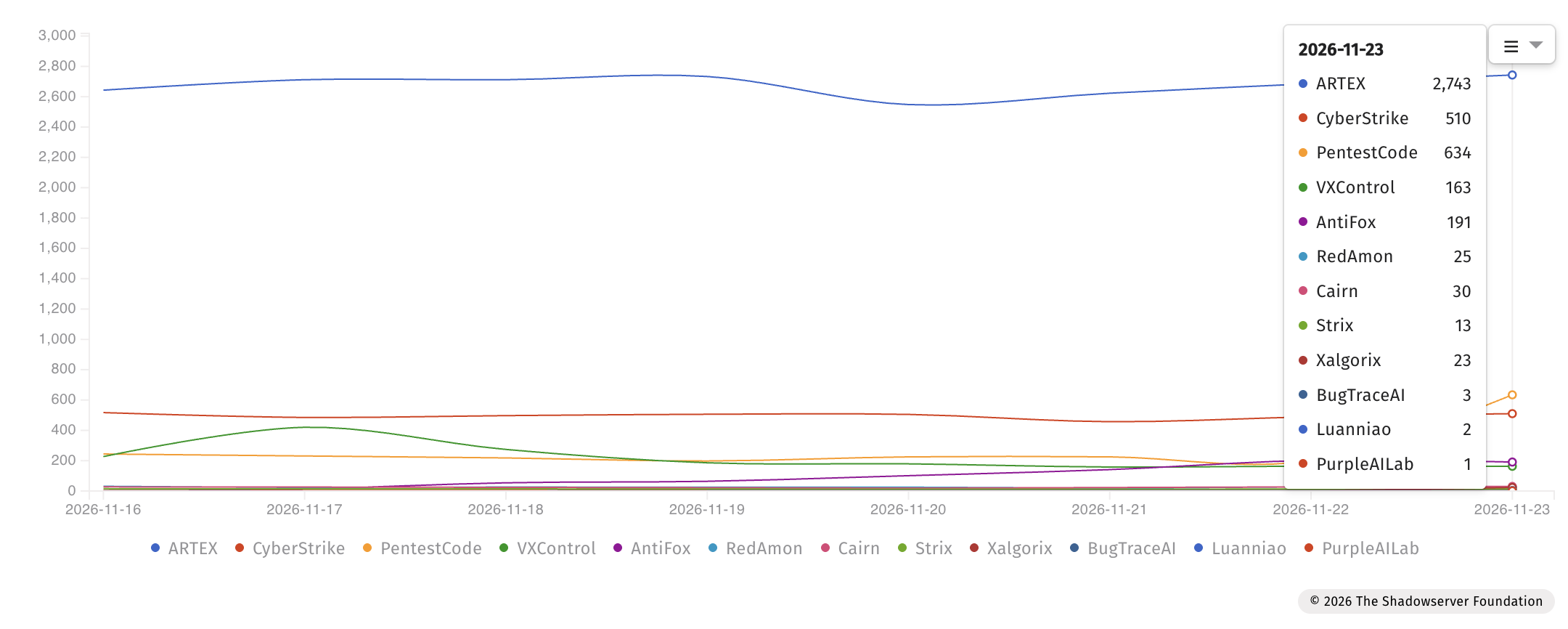
Exposed AI Attack Framework instances per framework – linear scale. Link to public Dashboard 2026-11-23
ARTEX accounted for around 70% of observed publicly exposed AI Attack Framework instances on most days, followed by CyberStrikeAI with around 500 and PentestCode with around 600. PentAGI (shown on the Dashboard as VXControl) fell from over 400 on 17 November to below 200. AntiFox, a fork of ARTEX, grew fastest, from a handful to around 200, so by 22 November ARTEX and AntiFox made up three-quarters of instances. On 23 November, PentestCode tripled to over 600, driving the week’s peak of over 4,300. The other seven frameworks together accounted for fewer than 100.
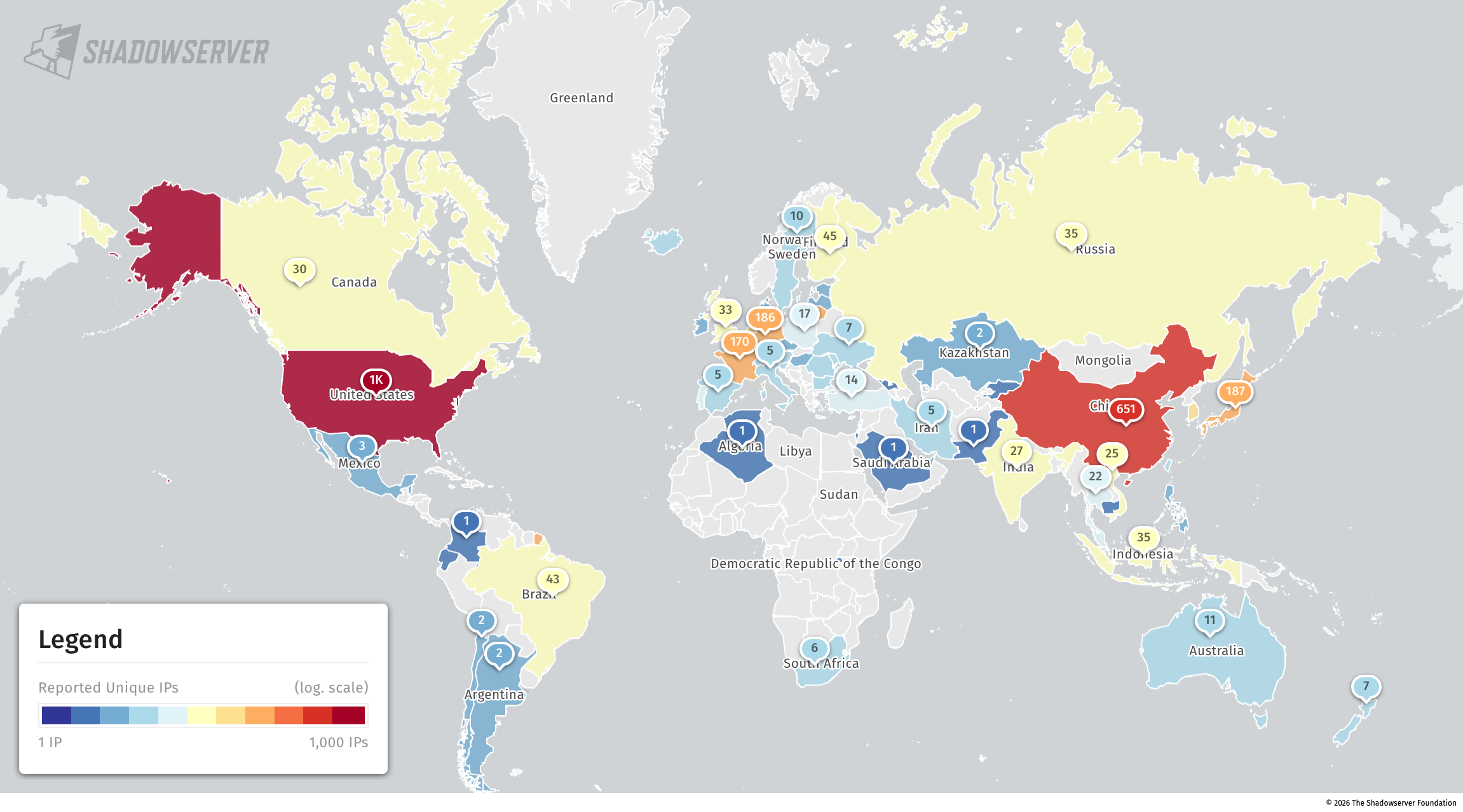
Exposed AI Attack Framework instances per country. Link to public Dashboard 2026-11-23
Accessing The Data
Data on publicly exposed AI Attack Framework instances is shared free of charge in our daily Device Identification report. In this report, device_type is set to ai-attack-framework, and the framework is identified in the device_vendor and device_model fields. IP addresses observed attacking our Global Honeypot Sensor Network are included in our honeypot event reports with the same labels. Country level statistics from devices fingerprinted as ARTEX Gateway and CyberStrikeAI (and others) can be tracked on our public Dashboard.
Honeypot Traffic Analysis
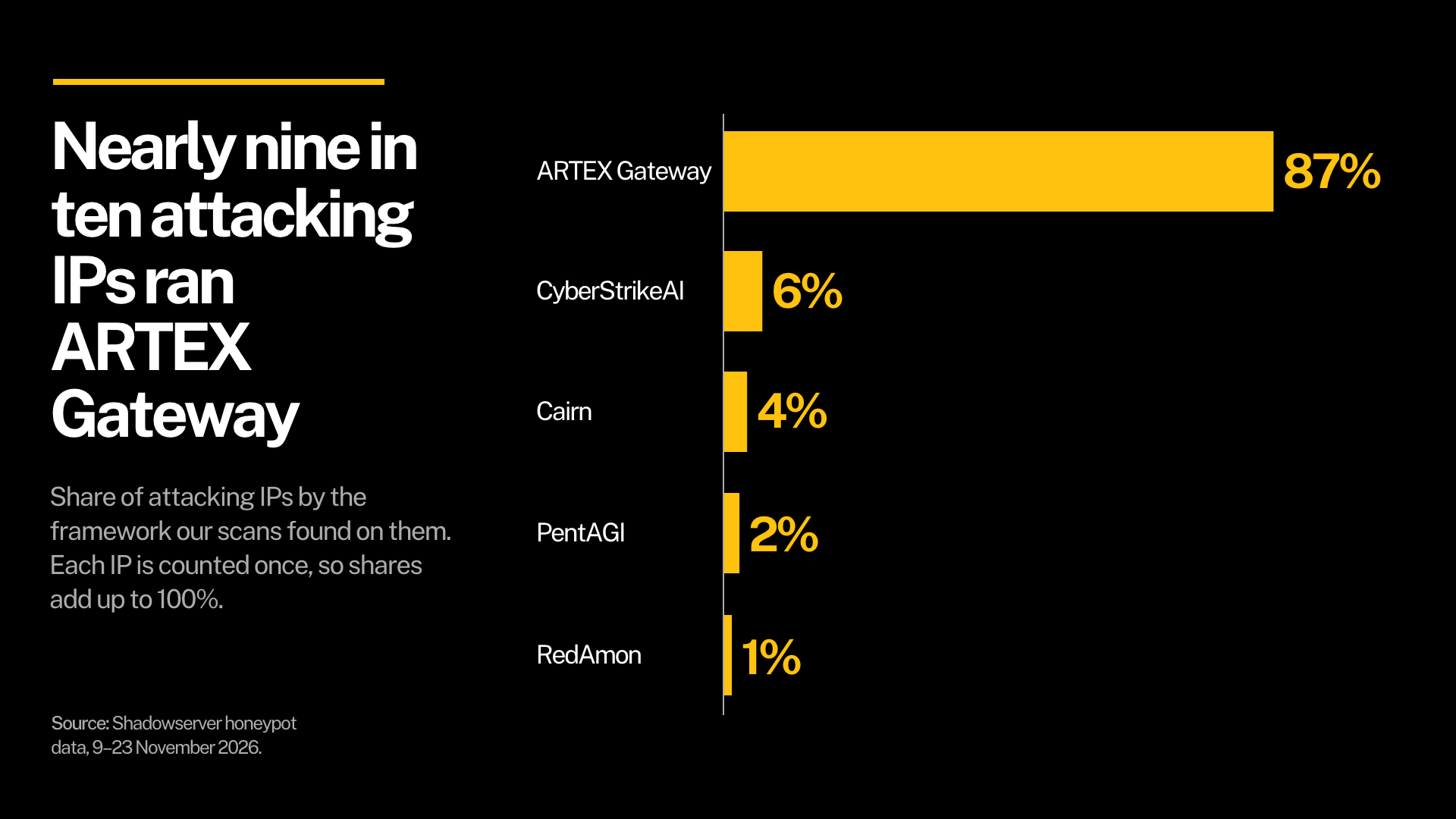
Between the 9th and 23rd of November 2026, more than 80 IP addresses fingerprinted as running AI Attack Frameworks generated more than 10,000 events across our Global Honeypot Sensor Network. A handful of IP addresses accounted for most of the events. Nearly nine in ten IP addresses were fingerprinted as running ARTEX Gateway, with smaller numbers running CyberStrikeAI, PentAGI, Cairn or RedAmon. The IP addresses were geolocated in more than 20 countries, but activity by source was concentrated in the United States and Hong Kong. As almost all of the IP addresses probing/attacking our Global Honeypot Sensor Network were on cloud networks, this most likely reflects where servers were hosted rather than where operators are based.
Which Frameworks the Attacking IP Addresses Ran
Nearly nine in ten attacking IP addresses were fingerprinted as ARTEX Gateway. CyberStrikeAI, Cairn, PentAGI and RedAmon made up the rest, with five IP addresses or fewer each. Although only two IP addresses ran PentAGI, one of them was the busiest IP address we observed. Each IP address is counted once, labeled as the framework that most of its events were associated with. Almost all requests carried browser-like user agents, many of them spoofed; the rest came from standard tools such as curl, python-requests, Go and aiohttp.
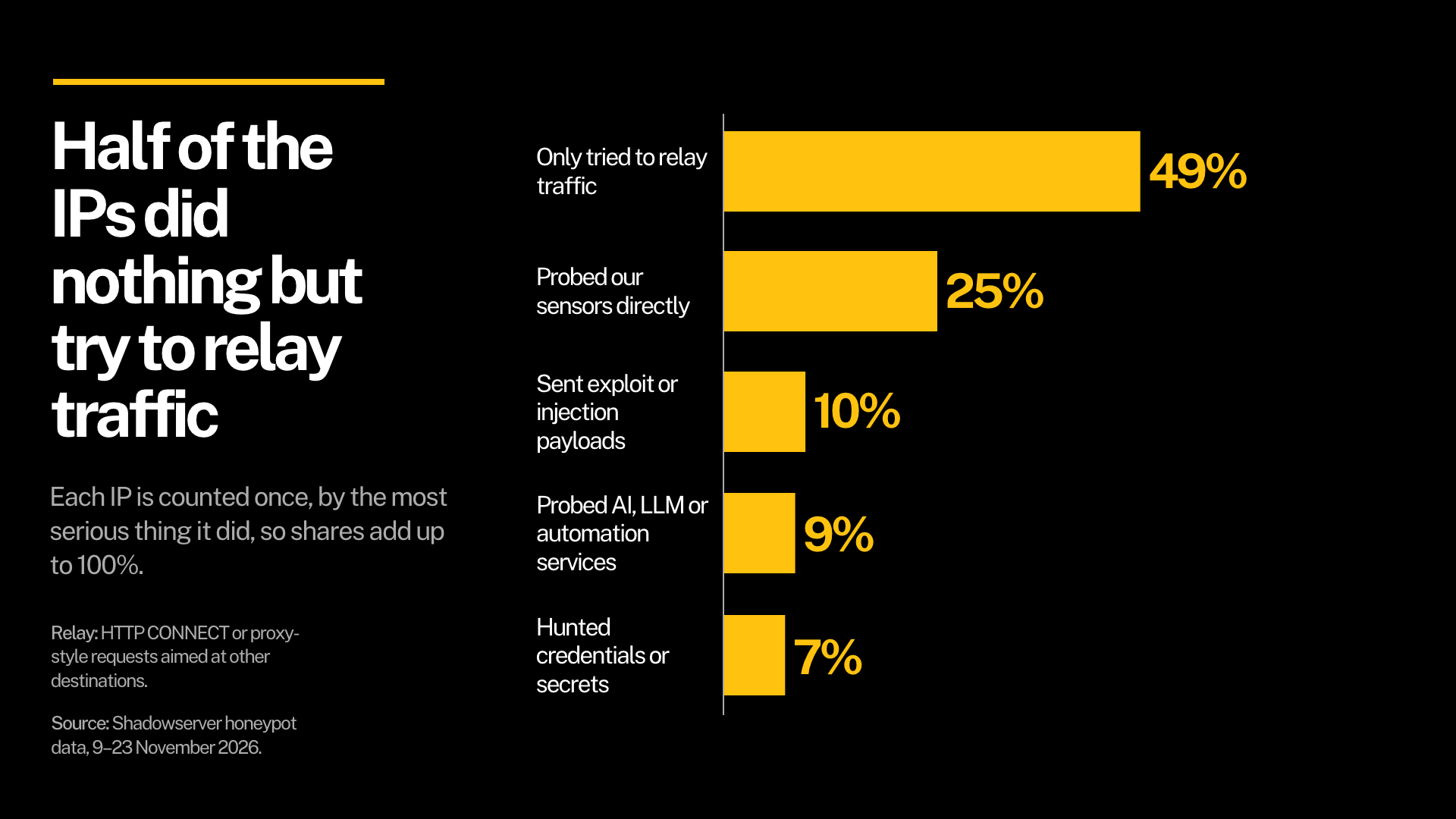
Half of the IP Addresses Tried to Relay Traffic
About six in ten IP addresses attempted to tunnel traffic through our sensors to other destinations. Payment, banking and crypto services drew over 40% of relay requests, although most came from two IP addresses; other destinations included online shops and SSH, MySQL and CouchDB servers.
A smaller number of IP addresses probed AI, LLM and automation services, including n8n, Dify, Flowise and MLflow instances, LLM model-listing endpoints, agent and LLM-provider APIs, and Model Context Protocol (MCP) endpoints.
Credential files associated with AI coding assistants were also targeted. Roughly one in ten IP addresses looked for credentials, including .env files (sometimes through path traversal) and Git metadata, or attempted logins with default credentials such as admin/admin on Jenkins. Two also tried to guess Telnet passwords. A .env file typically holds an application’s secrets, such as database passwords, cloud and payment API keys and, increasingly, LLM API keys, so a single exposed file can give an attacker direct access to those systems and services.
VPNs, Web Apps and Developer Tools were the Main Targets
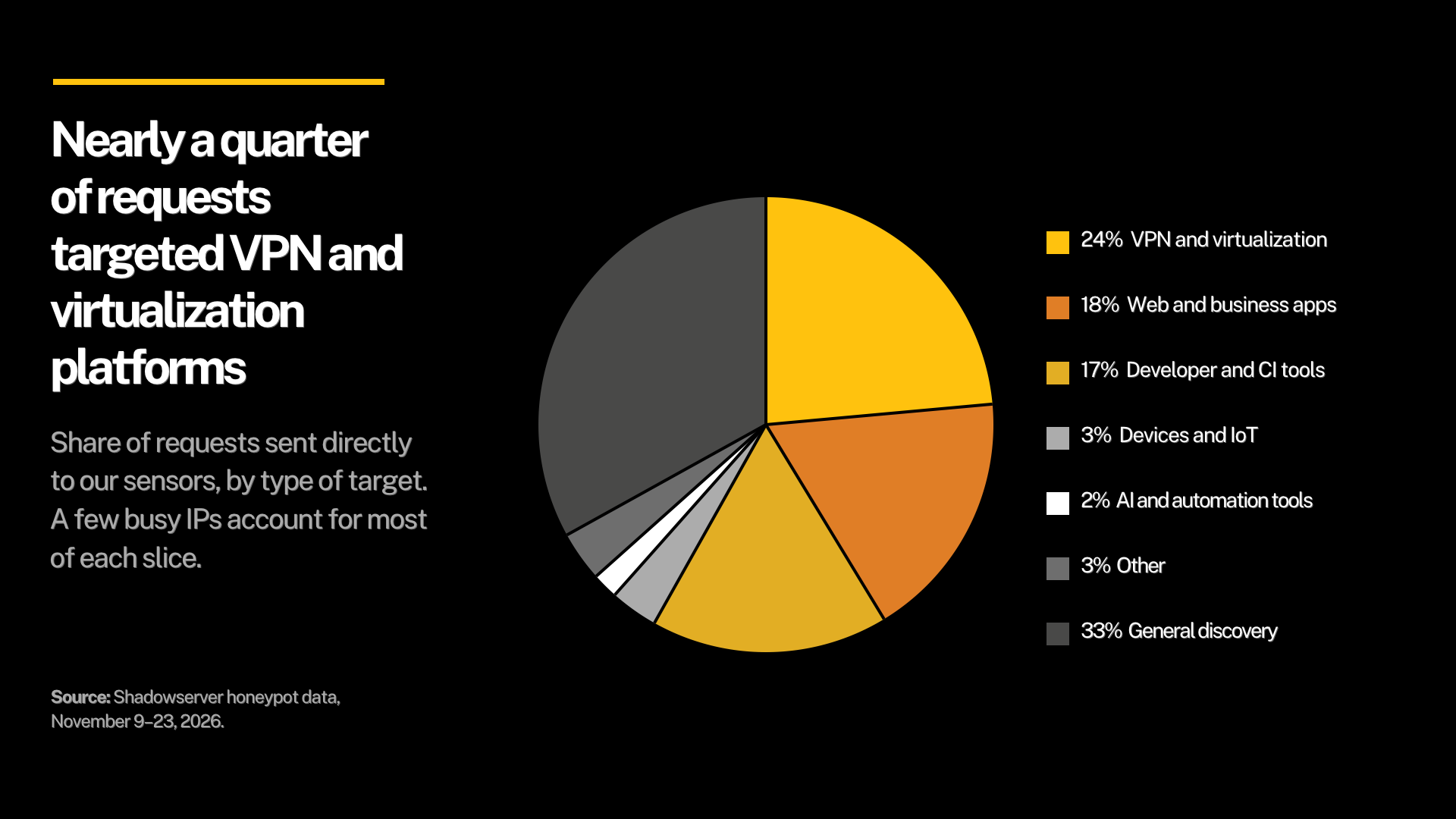
A third of the requests sent directly to our Global Honeypot Sensor Network were general discovery, such as HTTP requests for the home page. Most of the rest targeted VPN (virtual private network) and virtualization platforms, web and business applications, or developer tools such as continuous integration (CI) servers, which automatically build and test code. A small share went to devices and the Internet of Things (IoT), such as digital signage systems and routers. Each of these categories was driven largely by one or two busy attacking IP addresses. The most active IP addresses searched for VPN and remote-access gateways, VMware vSphere, Jenkins, Metabase and GeoServer. About one in ten IP addresses sent exploit or injection payloads, most often for Metabase CVE-2023-38646, along with PHPUnit CVE-2017-9841, Cisco IOS XE CVE-2023-20198 and GeoServer CVE-2024-36401.
Mostly Short Bursts, But Some Ran Around The Clock
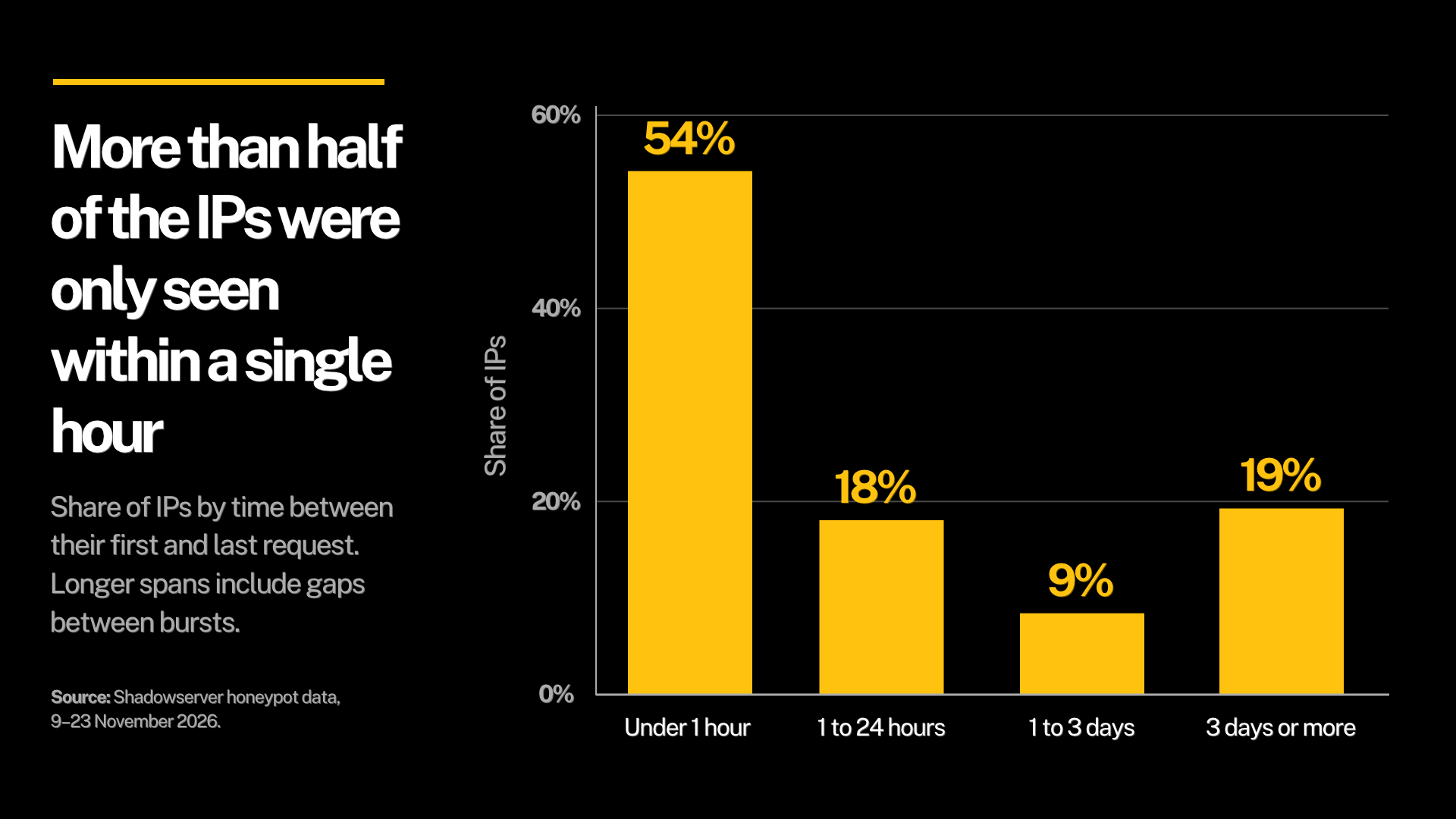
Much of this activity was automated: at peak, IP addresses sent dozens of requests in a single minute. Looked at IP by IP address, most worked in short bursts, and nearly half targeted our Global Honeypot Sensor Network for less than an hour in total. A few IP addresses, however, were active in every hour of the day over several days, which is consistent with automated tooling running around the clock.
Recommendations
- Subscribe to our free daily network reports: if you do not already receive our free daily network reports, subscribe here. They show every day which IP addresses on your network expose one of these frameworks and which have been seen sending traffic to our Global Honeypot Sensor Network, so you can act before publicly exposed instances are found and misused.
- Frameworks reported on your network: if our Device Identification report lists an AI Attack Framework on your network (device_type set to ai-attack-framework), verify that the deployment is authorized. If it is, restrict access to trusted addresses or a VPN, enforce strong authentication and keep the software updated. If it is not, isolate the instance and investigate it as compromised or misused.
- IP addresses listed in our honeypot reports with an ai-attack-framework label: such an IP address is running one of these frameworks and was seen sending traffic to our sensors. Confirm whether the activity is sanctioned. Hosting providers should review such reports under their abuse policies.
- Monitor for, and consider blocking, IP addresses known to run AI Attack Frameworks. Threat intelligence feeds can be used to seed blocklists. Review entries regularly, as hosting IP addresses are frequently reassigned, and note that some attacks arrive through intermediate proxies. Take care not to block IP addresses used for testing that you have authorized.
- Rate-limit and alert on rapid, iterative probing of a single target. Ensure that alerts are acted upon outside business hours, using automated response where possible.
If you are a national or sectoral CSIRT we would advise:
- Subscribing to the Shadowserver reports for your country and ASNs, and notify network owners and hosting providers, prioritizing government and critical infrastructure.
- Advise responders not to attribute activity by source IP address or country alone, and to retain proxy and gateway logs.
- Track exposure counts over time to show whether notification is reducing exposure.
Network owners and national CSIRTs that do not yet receive our reports may subscribe to our free daily network reports to obtain this data for their networks or constituencies.
More Information
- FBI FLASH-20261113-001: Threat Overview of ARTEX Autonomous Penetration Testing Framework
- NCSC (UK): Familiar weaknesses, exploited faster: defending against agentic cyber attacks
- CERT-EU: From Penetration Testing to Cyber Threat: Beware of ARTEX
- Canadian Centre for Cyber Security: Cyber threat actors increasingly use automated and AI-enabled tools in cyber attacks